

When specifying steel for a new application, one of the first decisions engineers and manufacturers make is whether to use hot-rolled or cold-rolled material. Although the two products begin with the same raw steel, the manufacturing process creates significant differences in appearance, dimensional accuracy, mechanical properties, cost, and inspection requirements.
Understanding those differences helps manufacturers select the right material while ensuring quality throughout production. More importantly, it highlights why inspection strategies cannot be one-size-fits-all.
What Is Hot Rolled Steel?
Hot-rolled steel is produced by heating steel above its recrystallization temperature, typically above 1,700°F (925°C), before passing it through a series of rolling mills that gradually reduce its diameter or thickness into the desired shape. Because the material is formed while it's hot and more malleable, manufacturers can efficiently produce large volumes of bars, rods, wire, structural shapes, and plate.
Before rolling begins, billets are reheated to restore the temperature needed for forming. During this stage, oxidation naturally occurs, creating a layer of surface scale. While this is a normal part of the process, excessive scale or improper processing can contribute to surface imperfections later in production.
The result is a product that offers:
- Lower production costs
- Efficient manufacturing of large volumes
- Good mechanical properties for many structural applications
- A rougher surface finish and wider dimensional tolerances
Because hot-rolled steel is often used in applications where appearance is less critical, it frequently undergoes additional machining or finishing before becoming a final product.
What Is Cold Rolled Steel?
Despite its name, cold-rolled steel doesn't start from scratch. It actually begins as hot-rolled steel.
After cooling, the material undergoes additional processing at room temperature, such as cold rolling, drawing, peeling, or grinding, to improve dimensional accuracy, surface finish, and mechanical consistency. These finishing operations create a cleaner, more precise product suitable for demanding applications like automotive components, precision shafts, bearings, and machined parts.
Compared to hot-rolled material, cold-rolled steel typically provides:
- Tighter dimensional tolerances
- Improved surface finish
- Better straightness
- Increased strength through cold working
The tradeoff is that every additional manufacturing step also creates new opportunities for defects or reveals imperfections that were previously hidden.
Hot-rolled vs. Cold-rolled
|
Hot Rolled |
Cold Rolled |
|
Formed above 1,700°F |
Processed at room temperature |
|
Lower production cost |
Higher production cost |
|
Rough surface finish |
Smooth surface finish |
|
Wider dimensional tolerances |
Tight dimensional tolerances |
|
Best for structural and general-purpose applications |
Best for precision components |
|
Common defects include seams, laps, rolled-in scale, and cracks |
Common defects include scratches, die marks, residual stress, and inherited seams |
|
Inspection must overcome surface noise |
Inspection must detect smaller surface imperfections |
Neither process is inherently better. The right choice depends on the performance requirements of the finished product.
How Manufacturing Influences Surface Defects
The rolling process also influences the types of defects manufacturers must monitor.
Hot-Rolled Products
As steel passes through the rolling mill, defects may be introduced or become more pronounced. Common surface discontinuities include:
- Seams
- Laps
- Rolled-in scale
- Surface cracks
- Non-metallic inclusions
Because hot-rolled material has a rougher surface and greater dimensional variation, inspection systems must distinguish true defects from normal surface conditions without sacrificing sensitivity or production speed.
Cold-Rolled Products
Cold-rolled and cold drawn products often inherit defects from earlier manufacturing stages while also introducing new challenges during finishing operations.
Common defects include:
- Die marks
- Surface scratches
- Residual stress
- Surface cracks
- Previously existing seams revealed during drawing
Although the surface is smoother, customer expectations are typically much higher. Even small imperfections can affect machining, heat treatment, coating, or final product performance.
Why Inspection Requirements Change
The differences between hot-rolled and cold-rolled products mean inspection strategies must adapt.
Hot-rolled bars require reliable detection despite rough surfaces, scale, and changing material conditions. Cold-rolled products demand higher sensitivity to identify much smaller discontinuities while minimizing false rejects.
In both cases, manufacturers face the same challenge: identifying defects before additional processing adds cost.
Finding a seam immediately after rolling is far less expensive than discovering it after machining, heat treatment, or shipment. Early inspection reduces scrap, prevents rework, and helps ensure customers receive material that meets specification.
Hot Rolled and Cold Rolled Inspection Solutions
Hot-rolled and cold-rolled products exhibit different surface conditions, defect types, and quality expectations. That means manufacturers need more than a single approach to surface inspection. The inspection technology and sensor configuration should match the material condition and the types of defects that need to be detected.
FOERSTER's latest generation of digital eddy current systems gives manufacturers the flexibility to address these different inspection requirements while bringing inspection control, evaluation, visualization, and documentation together within a common software platform.
DEFECTOMAT DA for Flexible Surface Inspection
 The DEFECTOMAT DA builds on proven eddy current inspection technology for semi-finished long products. It is designed for high-speed detection of short and transverse surface defects and can be applied to a range of product geometries and surface conditions.
This flexibility can be particularly valuable for producers inspecting a mix of hot-rolled and cold-finished products. Digital signal processing provides improved signal-to-noise performance, helping operators distinguish relevant indications from background signals while maintaining reliable inspection at production speed.
The DA generation also modernizes the inspection platform itself. Its modular, fully digital architecture supports future Windows operating system upgrades and continued software improvements throughout the life of the equipment. For more demanding applications, the DEFECTOARRAY sensor can further improve inspection performance and provide more detailed information about defect location.
CIRCOGRAPH DA for Longitudinal Defects on Bright Products
Cold-finished products introduce a different challenge. Drawing, peeling, grinding, and other finishing operations create smoother, more uniform surfaces, in which smaller defects become increasingly important to final product quality.
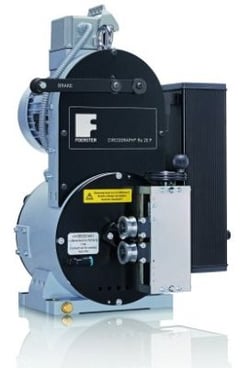 The CIRCOGRAPH DA is a contactless eddy-current inspection method for longitudinal surface defects on bright products. Its rotating sensors scan the circumference of the material as it moves through the inspection system, providing high sensitivity to surface-breaking longitudinal defects.
This makes CIRCOGRAPH particularly relevant for bright and cold-finished products, where improved surface quality allows smaller discontinuities to be reliably detected. Digital signal processing directly at the sensor also supports high reproducibility and minimizes susceptibility to external interference, helping maintain inspection performance at production speed.
One Digital Platform for a Broader Inspection Strategy
For manufacturers that need to detect multiple defect orientations, DEFECTOMAT DA and CIRCOGRAPH DA can also be used together. Rather than operating as completely separate inspection environments, both systems are controlled through DEFECTOTEST DA ECT.
The common software platform brings inspection control, signal evaluation, visualization, and documentation into a single interface. Operators can view inspection data in real time, configure workspaces for different inspection tasks, archive results, and generate inspection reports.
Advanced visualization provides additional insight into where defects occur around the circumference and along the length of the material. This can help quality teams move beyond simply identifying defective material and begin recognizing recurring defect patterns that may point back to the production process.
For manufacturers producing both hot-rolled and cold-rolled material, this offers a more adaptable approach to inspection. The sensor technology can be selected according to the surface condition and defects being targeted, while the underlying digital platform provides a consistent way to operate, evaluate, document, and integrate inspection throughout production.
The DA generation systems combine trusted inspection performance with the digital infrastructure needed to support today's production lines and tomorrow's manufacturing requirements.
Hot Rolled vs. Cold Rolled in 60 Seconds
Before you go, here's a quick review of the key concepts. If you can answer these five questions, you've got a solid understanding of the differences between hot-rolled and cold-rolled steel—and why inspection matters.
What is the primary difference between hot-rolled and cold-rolled steel?
Hot-rolled steel is shaped at high temperatures, while cold-rolled steel undergoes additional processing after cooling to improve surface finish and dimensional accuracy.
Why does hot-rolled steel have a rougher surface?
Reheating and high-temperature rolling naturally create surface scale and greater dimensional variation.
Why are quality requirements often higher for cold-rolled products?
They are typically used in precision applications where even small surface imperfections can affect performance.
Do hot-rolled and cold-rolled materials require the same inspection approach?
No. Each presents different surface conditions and defect types that require different inspection strategies.
Why is early inspection important?
Detecting defects before value-added processes reduces scrap, rework, warranty claims, and production costs.
Choosing between hot-rolled and cold-rolled steel is an important material and inspection decision. Understanding how each product is manufactured helps manufacturers select the right quality assurance strategy, detect defects earlier in production, and reduce the costly impact of scrap, rework, and customer complaints.
Share this
.png)
Detecting Longitudinal Cracks in SBQ Bars with Eddy Current Testing
Prevent Unexpected Wire Breaks Triggered by Inclusions
.png)