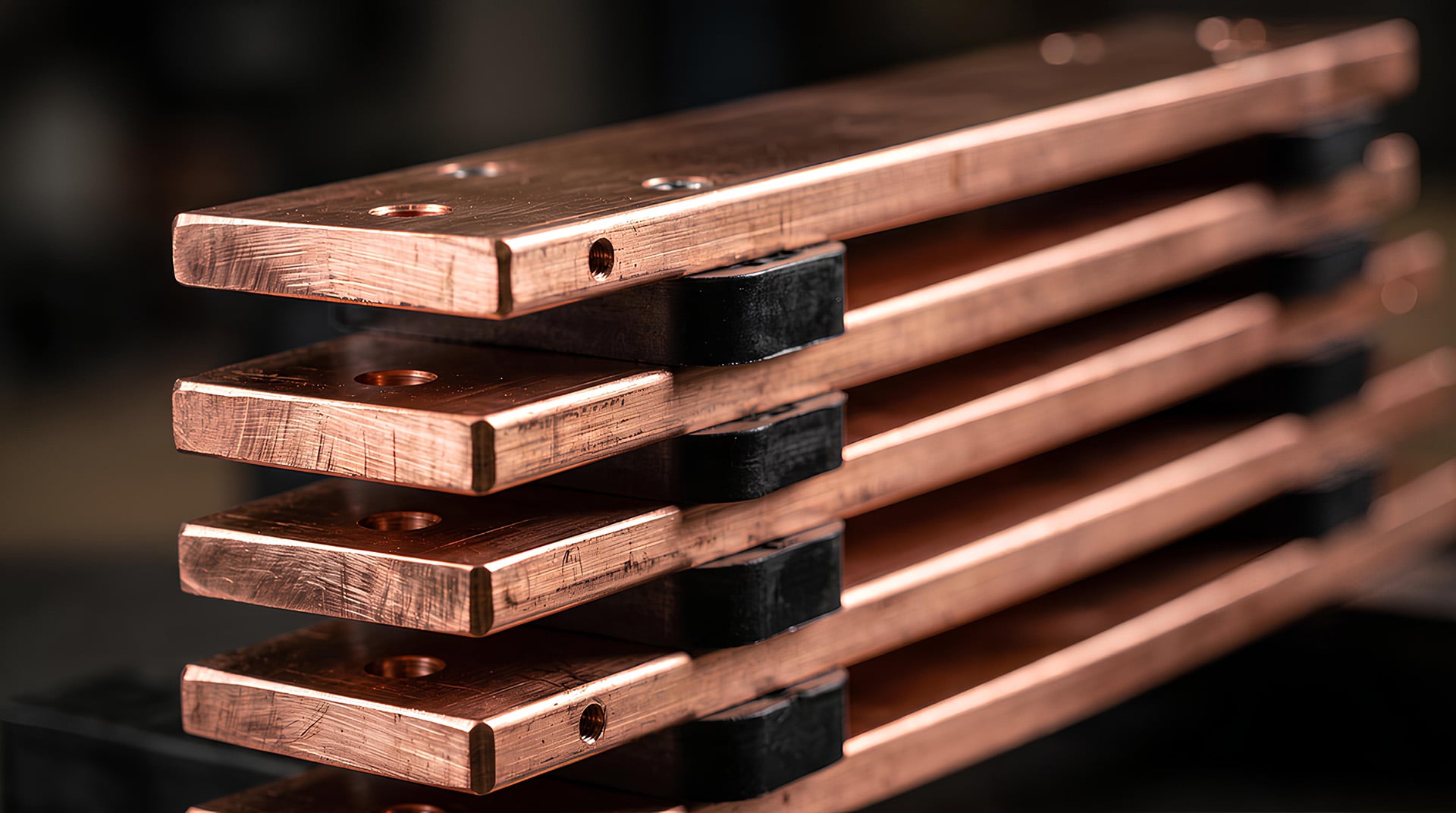
Copper continues to be one of the world’s most important industrial materials. Demand continues to grow across electrical infrastructure, renewable energy systems, electric vehicles, data centers, and advanced electronics.
According to the International Energy Agency (IEA) analysis, currently operating and announced copper mines may meet only around 70% of projected global copper demand by 2035. As copper becomes increasingly valuable, manufacturers face greater pressure to maximize yield, reduce scrap, and ensure material quality throughout production.
Knowing exactly what material you have is more important than ever.
Conductivity testing is one of the fastest and most effective non-destructive methods for verifying copper quality, confirming alloy composition, supporting material sorting, and validating production processes. However, even the most sophisticated conductivity measurement can yield misleading results if temperature is not properly accounted for.
Why This Matters
- Copper demand continues to grow due to data centers, electrification, renewable energy, AI infrastructure, and grid modernization.
- Material mix-ups and unnecessary scrap carry a higher financial impact when copper prices are elevated.
- Accurate conductivity testing helps manufacturers make confident decisions about material quality and usability.
Why Accurate Copper Conductivity Testing Is Critical
Conductivity testing is used at nearly every stage of copper production, from incoming material and revert verification toalloy identification to final quality inspections. Manufacturers rely on conductivity measurements to verify material quality, confirm heat treatment results, support material sorting programs, and ensure finished products meet performance requirements.
Because conductivity is directly related to a material’s electrical properties, it provides valuable insight into alloy composition, condition, and potential performance. The test can be performed quickly and non-destructively using eddy current , making it well-suited for both laboratory and production environments.
The benefits extend beyond quality control. There is also a significant financial impact. An unaccounted-for 10°C temperature difference between the probe and the material can lead to conductivity readings that fall outside acceptable limits. In high-volume production environments, that can mean scrapping thousands of pounds of conforming material, or worse yet, shipping product that does not meet specifications.
As copper demand continues to rise, avoiding those costly mistakes becomes increasingly important.
Why Temperature Compensation Matters in Copper Conductivity Testing
Conductivity instruments like the SIGMATEST are calibrated using certified reference standards in carefully controlled environments. In a laboratory, standards and test samples can be stabilized at the same temperature before measurements are taken. Manufacturing environments are rarely that predictable.
A technician may need to inspect hot billets that have just left the production line, followed by material that has been stored overnight in a cold warehouse. Environmental conditions, material handling practices, and production schedules can all introduce significant temperature variations. Since copper’s electrical resistance changes predictably with temperature, those variations can influence conductivity readings even when the material itself remains unchanged.
Waiting for the material, probe, and standards to reach the same temperature is often impractical. Instead, temperature compensation is used to correct measurements and improve accuracy. Copper typically exhibits a temperature coefficient of approximately 0.00393 per degree Celsius, allowing conductivity values to be adjusted to a common reference temperature.
While the mathematics behind temperature compensation can be complex, modern conductivity instruments automate the process. Systems such as the SIGMATEST 2.070 apply temperature compensation algorithms, helping operators obtain reliable and repeatable measurements without manual calculations.
How SIGMATEST Simplifies Conductivity Testing in Real-World Conditions
Historically, many facilities relied on external temperature probes when performing conductivity measurements. While effective in stable environments, these approaches can become cumbersome when testing materials with rapidly changing temperatures.
Some manufacturers have developed creative workarounds to overcome these challenges. One facility implemented a process where samples were heated in an oven before testing to standardize temperatures. Another operation required technicians to collect multiple measurements, transfer data between operators, perform calculations using external software, and manually average the results before making a final decision.
While these methods can function, they require significant time, labor, and process control, introducing risk to the process.
The SIGMATEST 2.070 was developed to help manufacturers obtain accurate conductivity measurements without adding unnecessary complexity to the testing process. A default temperature coefficient is included with every instrument, and users can define application-specific temperature coefficients to optimize testing for particular materials and production requirements.
The Smart Probe further simplifies testing by compensating for normal environmental temperature fluctuations while reducing dependence on external temperature probes.
For applications involving larger temperature differences, operators can quickly create, edit, and save test profiles directly on the instrument. A calibrated infrared thermometer can be used to measure the test area temperature, which is then entered into the test profile. The SIGMATEST automatically applies the appropriate compensation calculations, reducing operator workload while improving measurement consistency.
The result is a faster, more repeatable testing process that helps manufacturers make confident material decisions without slowing production.
Key Takeaways for Copper Producers and Manufacturers
As copper demand continues to grow, material verification becomes increasingly important. Conductivity testing remains one of the most effective non-destructive methods for verifying copper quality, supporting material sorting, and validating production processes.
However, conductivity measurements are only as reliable as the testing methodology behind them. Temperature variation can have a significant impact on measurement accuracy, leading to unnecessary scrap, material mix-ups, and costly production decisions.
By combining proven conductivity measurement technology with intelligent temperature compensation features, manufacturers can improve accuracy, reduce waste, and make more informed decisions throughout the production process.
Extensive laboratory validation and successful implementation in copper foundries and manufacturing facilities continue to demonstrate the value of temperature-corrected conductivity testing in real-world applications.
Frequently Asked Questions About Copper Conductivity Testing
What is copper conductivity testing?
Copper conductivity testing measures a material’s ability to conduct electrical current. It is commonly used for quality control, material verification, alloy identification, heat treatment verification, and material sorting.
Why does temperature affect conductivity measurements?
Copper’s electrical resistance changes as temperature changes. If temperature differences are not accounted for, conductivity readings can vary even when the material itself remains unchanged.
Should conductivity testing be used for material sorting?
Yes. Conductivity testing is widely used to distinguish between copper grades and alloys, verify incoming material, and prevent costly material mix-ups.
What is temperature compensation?
Temperature compensation adjusts conductivity measurements to account for differences between the test piece temperature and the reference temperature. This helps ensure measurements remain accurate and repeatable.
Why use eddy current conductivity testing?
Eddy current conductivity testing is fast, non-destructive, and well-suited for production environments where material verification must be performed without damaging the product.