Fasteners are often treated as “set and forget” once they are installed. The reality is that rivets and bore holes in aerospace structures are subjected to repeated stress, vibration, and environmental exposure throughout their service life.
If your team is still relying on manual or visual inspection methods, defects and damage can progress unnoticed. By the time a defect becomes visible on the surface, it is often already well developed and far more difficult to manage.
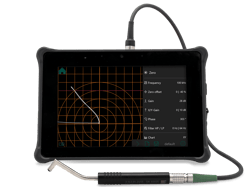 This is where eddy current testing changes the inspection approach. When paired with the right tools and sensors, it allows you to evaluate rivets and boreholes with far greater confidence. Solutions like the FOERSTER TCM, combined with appropriate probes, enable thorough, repeatable inspection directly where it is needed.
Why Eddy Current Rivet Inspection Matters in Aerospace
When you are responsible for verifying fastener integrity, missing a defect is not a small oversight. A rivet is rarely a standalone feature. It is part of a load-bearing system, and if it fails, the surrounding structure is immediately at greater risk.
Traditional inspection methods, while better than nothing, create a gap between when a flaw forms and when it is actually detected. Visual and manual techniques are limited to surface conditions and do not provide insight into early-stage subsurface cracking or corrosion, where many fastener failures begin.
When flaws go undetected, the impact compounds quickly:
-
Structural risk increases as cracks continue to propagate beneath the surface.
-
Repair costs increase as damage spreads beyond the original rivet or bore hole.
-
Unplanned downtime increases as issues are discovered too late.
-
Uncertainty in inspection results increases in high-cycle, fatigue-prone areas.
-
Compliance risk increases as inspection methods fail to meet evolving regulatory expectations.
At the same time, inspection requirements continue to tighten. We are expected to prove not only that fasteners are present and secure, but that hidden damage is being actively managed.
This is why non-destructive testing methods, and specifically eddy current testing, are becoming essential for aerospace fastener inspection. Eddy current allows us to detect flaws earlier, inspect without disassembly, and increase confidence that critical rivet and fastener locations have been thoroughly evaluated before they become a larger problem.
How the FOERSTER TCM Supports Reliable Rivet Hole Inspection
Using eddy current in rivet hole inspection allows you to find hidden cracks and corrosion early, without removing fasteners or disrupting the surrounding structure. With earlier insight, you can protect structural integrity, reduce downtime, and make faster, more confident maintenance decisions. Eddy current rivet hole inspection is especially effective in aerospace applications where access is limited and inspection consistency is critical.
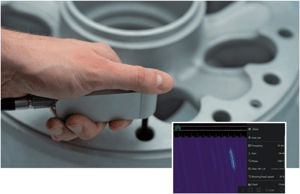 The TCM by FOERSTER is designed specifically for mobile, high-confidence eddy current inspection in demanding environments. Its compact, modular design makes it well-suited for aerospace applications where access, repeatability, and efficiency all matter.
When paired with a rotating handheld probe, the TCM enables consistent inspection around rivets and fastener holes. The rotating motion ensures full circumferential coverage, reducing sensitivity to probe orientation and improving repeatability across inspections. This is especially valuable in high-cycle, fatigue-prone areas where consistency is critical.
From a day-to-day inspection standpoint, the benefits are clear:
-
Faster inspections with minimal disruption to maintenance or production schedules
-
Higher confidence in results through stable signals and repeatable probe positioning
-
Efficient coverage of high-risk areas without disassembly
-
Lower total inspection cost by reducing labor and rework
-
Rapid inspection of critical areas to support timely decisions
Because the TCM supports a wide range of probes and sensors, it also allows teams to tailor inspections to specific materials, fastener types, and different geometries. Selecting the right sensor or probe is key to achieving reliable results.
By combining eddy current inspection with a flexible platform like the TCM, we are helping teams move beyond surface-level checks and gain meaningful insight into fastener integrity where it matters most.
Key Takeaways for Aerospace Fastener Inspection
When it comes to fastener inspection, a few clear action scan significantly reduce risk and improve confidence:
-
Look beyond visual inspection for rivets and fastener holes.
-
Prioritize high-cycle, fatigue-prone fastener locations.
-
Use eddy current to detect subsurface cracks and corrosion early.
-
Match probes and sensors to fastener geometry and material.
-
Utilize mobile inspection tools to reduce downtime.
Rivets and fasteners may be small, but their impact on structural integrity is significant. By moving beyond surface-level inspection and adopting eddy current testing with the right tools, you can detect problems earlier, reduce unnecessary downtime, and make more confident decisions about the assets you are responsible for. The TCM, paired with a rotating hand held probe, provides a practical and reliable way to ensure critical fastener locations are thoroughly inspected.
Share this
.png)
Improving Bar and Tube Inspection with Advanced Eddy Current Technology

Real-World NDT Applications for Manufacturing and Quality Inspection